Louis Vuitton Turns Murakami Nostalgia Into a Summer Finale
Louis Vuitton closed its three-part Murakami re-edition with Zendaya, a cherry motif and an animated summer campaign designed to make a 20-year-old collaboration feel newly collectible.
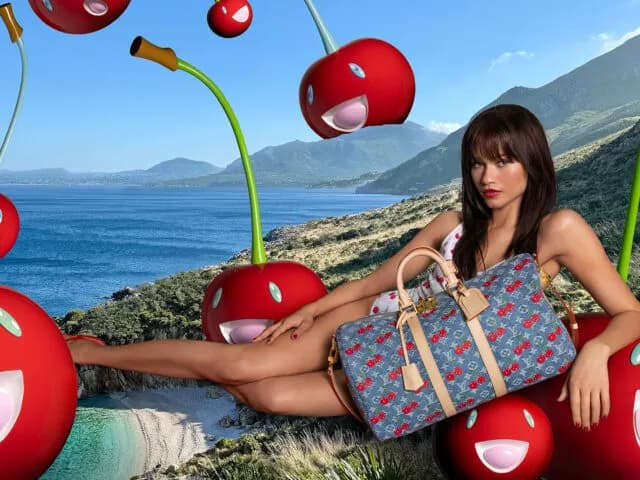
Louis Vuitton’s third and final Murakami re-edition chapter put House Ambassador Zendaya at the center of a summer campaign built around Takashi Murakami’s Cherry motif. The move converted an archive collaboration into a season-ending product story across bags, shoes, fragrance and accessories, using animation and celebrity-scale imagery to make the collection feel playful rather than purely retrospective.
Description
Louis Vuitton used Chapter Three to complete the 2025 re-edition of its landmark collaboration with Japanese artist Takashi Murakami, originally introduced in 2003. This final release centered on Murakami’s Cherry motif and positioned Zendaya as the campaign’s visible bridge between the house’s early-2000s cultural cachet and a current luxury audience. The market objective was not simply to reissue recognizable prints: it was to turn an established collectible code into a fresh summer retail moment, spanning leather goods, footwear, fragrance and accessories. What makes the move notable is the discipline of the format. Rather than revive the entire collaboration in one burst, Louis Vuitton serialized it into three chapters and reserved a bright, instantly legible visual asset for the finale.
Highlights
- Chapter Three was presented as the third and final installment of the Louis Vuitton x Murakami re-edition collection.
- House Ambassador Zendaya fronted the campaign.
- The creative centered on Takashi Murakami’s Cherry motif, giving the finale a distinct seasonal code.
- Louis Vuitton described the advertising as an animated campaign with a playful holiday and summer spirit.
- The release covered signature bags, shoes, perfume and accessories rather than limiting the collaboration to handbags.
- The campaign was listed as a 360-degree fashion campaign with 13 media assets, indicating a broader asset system than a single fashion image.
Results
01
Exact commercial results for Chapter Three were not publicly disclosed. No verified sales, sell-through, media-reach, engagement, spend or conversion figures were found for this specific final drop. The public evidence does show a deliberately scaled launch: Louis Vuitton supported the release with an animated campaign, Zendaya-led imagery and a multi-category product range, while the campaign was classified as 360-degree and documented across 13 assets. The broader re-edition was also built as a three-part program, extending attention beyond a one-off capsule.
Lowlights
- Louis Vuitton did not publish Chapter Three revenue, unit volume, sell-through or ROI, so the commercial impact cannot be independently measured.
- The campaign’s 360-degree classification confirms breadth, but the available record does not specify channel weighting, paid-media investment, market-by-market rollout or creator strategy.
- Nostalgia is a powerful acquisition and attention device, but it can narrow the audience to consumers already attached to the original Murakami era.
- Zendaya supplies reach and cultural relevance, yet her presence can draw attention toward campaign imagery more than the product design system if the assets do not make individual items memorable.
MAD's Verdict
Smart move. Louis Vuitton did not treat nostalgia as a museum exercise; it used a familiar collaboration as a repeatable retail engine, then gave the final installment its own seasonal reason to exist. The Cherry motif is doing more work than a logo refresh: it supplies an immediate visual hook for campaign assets, makes the collection easy to recognize at speed and gives a wide product range one coherent story. This is really for affluent millennials who remember the original and younger luxury shoppers who recognize its Y2K-coded visual language without needing the backstory. Louis Vuitton is betting that a serialized archive revival can create several purchase moments instead of exhausting demand at launch. It will win where the product is visibly collectible and the campaign keeps the Cherry code front and center. It will fail where consumers experience the program as another expensive reprint without enough product distinction or access.
Industry Opinions
FashionUnited framed the final drop as a nostalgia-led luxury bet, noting that the campaign returned to the Cherry motif for its summer conclusion. That supports the view that the campaign’s commercial job was cultural recall as much as seasonal merchandising. Luxury Daily’s analysis of the three-part re-edition emphasized its ability to reconnect Louis Vuitton with Murakami while reviving early-to-mid-2000s nostalgia. The important strategic point is the format: the house made a legacy collaboration operate as an extended contemporary campaign, not a single anniversary announcement.
Takeaways
- Висновок 01
If an archive collaboration has more than one recognizable visual code, separate those codes into chapters so each release gets a distinct reason to be noticed.
- Висновок 02
If a capsule spans multiple categories, choose one strong motif, such as the Cherry, that can unify bags, footwear, fragrance and accessories without requiring extra explanation.
- Висновок 03
If the brand needs both heritage credibility and current relevance, pair the original creative collaborator’s signature with a current ambassador who can carry the visual system into culture.
- Висновок 04
If a reissue risks looking static, build campaign assets around motion or animation so familiar product codes feel active in social and digital placements.
- Висновок 05
If performance data is not public, do not confuse visible campaign scale with proven commercial success; track sell-through, waitlist demand, repeat purchase and category lift internally.